Loading your cart
Extended Flash Sales Ends
0Days
00Hrs
00Mins
00Secs

Your cart
Recent searches
Popular searches
Your cart
Recent searches
Popular searches

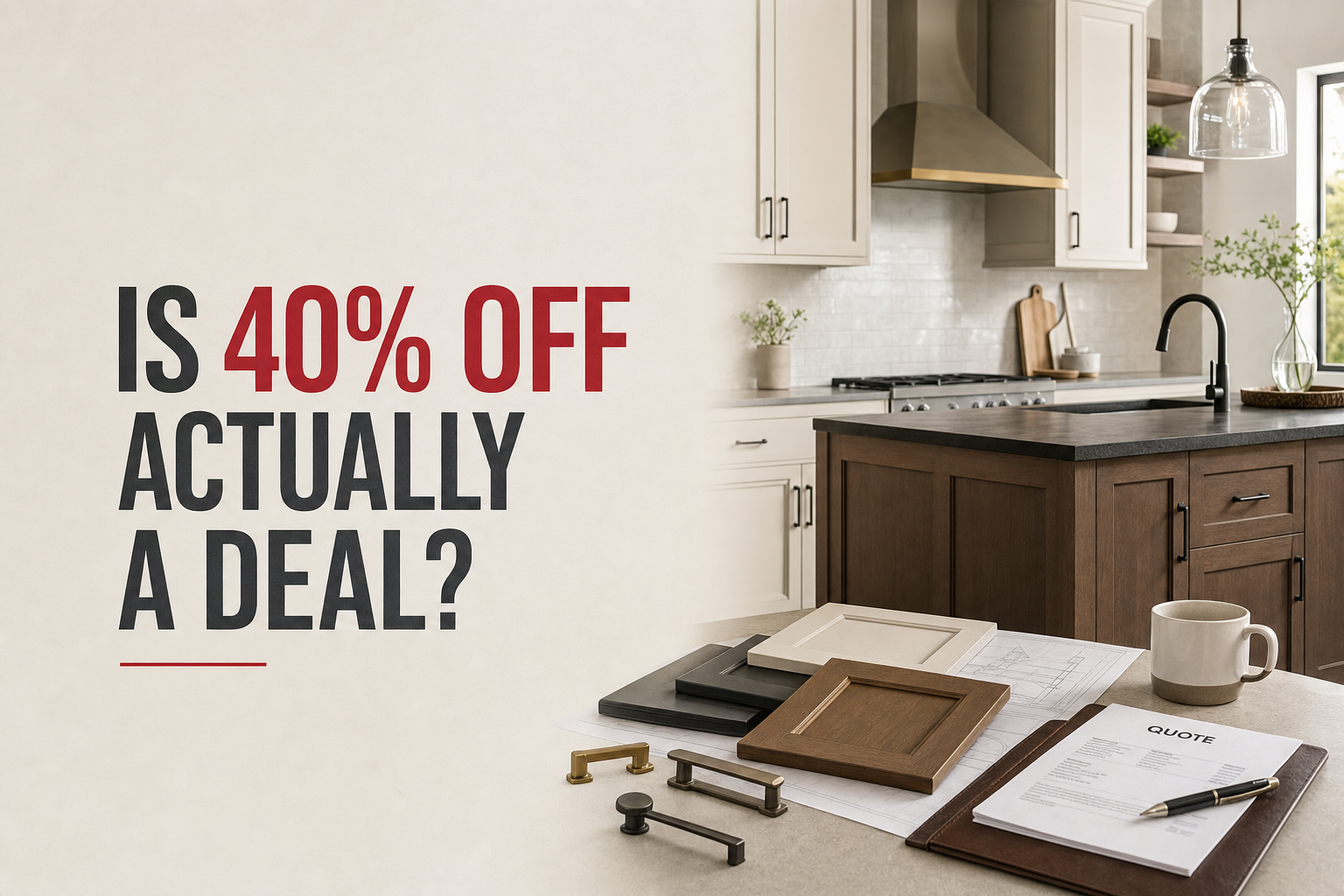
A big discount percentage does not tell you the final price. Stores calculate “30% off” or “40% off” against their own list price, and list prices are not the same from one retailer to the next. The only way to know if a sale is actually a good deal is to compare the final itemized total for your exact kitchen—same boxes, same panels, same hardware, same shipping, same warranty.
We help homeowners compare quotes every day, and this is the number one thing people miss. Most homeowners buy cabinets once or twice in their life. Our designers compare quotes and build kitchens constantly, and we can tell you in five minutes if a “sale” is real or just a bigger number crossed out next to a smaller number.
Here’s the trick with list prices. A store can set their “regular price” high, then knock 40% off it and still land at a price that is higher than what another company charges every single day with no sale at all. The 40% is real math, but it is math against a number that store made up.
Think of it like a mattress store that always has a “50% off blowout sale.” If the sale never ends, the sale price is the regular price. Some cabinet retailers run their pricing the same way. That does not mean they are lying to you. It just means the percentage off is not useful information by itself.
The number that matters is the dollar amount you actually pay for a complete kitchen, delivered to your door.
Before you trust any discount, pull together the full itemized basket. That means every line item that will actually show up in your kitchen, not just the box prices.
Those last few items are the ones that quietly wreck a “great deal.” Fillers, panels, and trim alone can add $500 to $2,000 to a kitchen depending on the layout. If one quote includes all of that and another quote is missing half of it, the lower number on paper is not actually the lower price.
A sale price only means something if you’re comparing the same cabinet. Two boxes can look identical in a photo and be completely different once you open the door.
A 40% off particleboard cabinet is still a particleboard cabinet. If the comparison quote is for a full plywood box with soft-close everything, you’re not comparing a sale to a sale. You’re comparing two different products, and the “discount” one is usually the lower-quality one.
Price and construction matter, but so does what happens five years from now if a hinge breaks or a drawer box splits. A kitchen is not a one-time purchase, it’s something you live with every day for decades. USA Cabinets backs our cabinets with a lifetime warranty, so if something goes wrong down the road, you’re covered. If a sale cabinet comes with a shorter warranty or no real warranty at all, that’s part of the real cost even though it never shows up on the invoice.
Here’s the simple method. Take your existing quote, or the sale quote you’re looking at, and line it up item by item next to another quote for the exact same kitchen.
Once you do that, the 30% or 40% off sticker doesn’t matter anymore. You’re looking at two complete kitchens with two real prices, and you can see which one is actually better.
We help customers save about 25% on average through wholesale pricing, and we back it with a 5% savings guarantee on comparable cabinet quotes. That’s not a flash sale number — it’s our everyday pricing against comparable quality. If you already have a quote from a “30% off” sale, send it to us and we’ll build a matching, itemized comparison for your exact kitchen so you can see the real numbers side by side, not just the percentage on the headline.
Does a bigger discount percentage always mean a lower price?
No. The percentage is calculated against that retailer’s own list price, which can vary a lot between companies. A smaller discount off a lower starting price can still land at a better total.
What should I ask a retailer running a sale?
Ask for a full itemized quote that includes fillers, panels, trim, hardware, assembly, freight, and tax — not just the box prices. Ask what the boxes are made of and what the warranty covers.
Is it worth comparing a sale quote to a wholesale quote?
Yes. Wholesale pricing skips extra markup that a sale discount is often calculated from in the first place, so the final total is frequently lower even without a flashy percentage attached to it.
Attach your existing quote through our free design request. We’ll compare it line by line and help you see whether you’re actually getting a good deal.
Savings, availability, and shipping times can vary by cabinet line and order.